
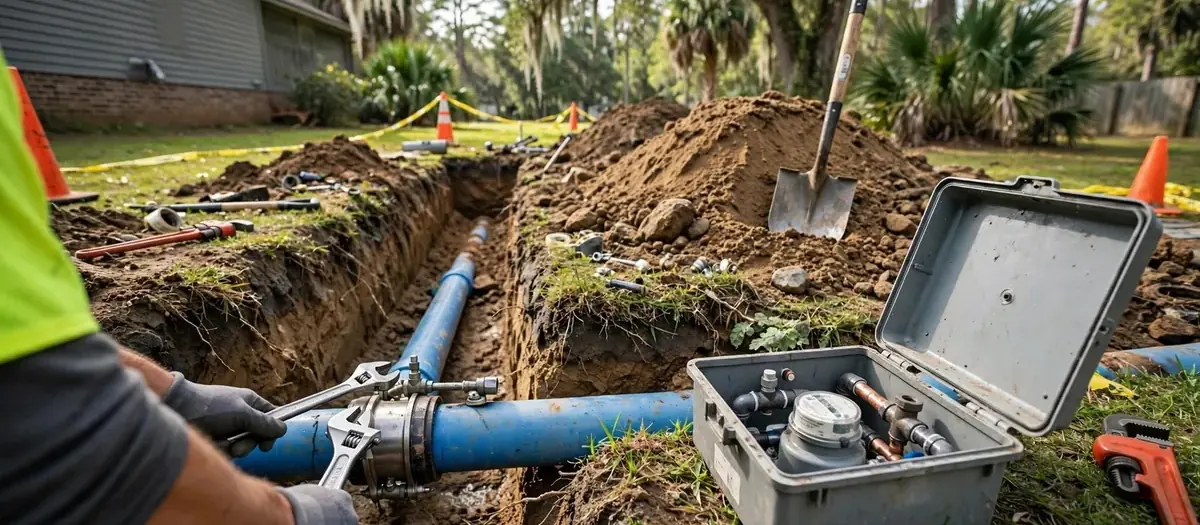
Three places to shut the water, from smallest to biggest
The right valve depends on how big the leak is. A dripping toilet supply needs only its own stop valve. A burst pipe needs the house main. If the house main will not close, the last resort is the meter valve in the yard.
Learn all three while nothing is wrong. A valve that has not moved in ten years may refuse to turn the first time you need it, and finding that out during a leak is the worst timing.
Find them in this order
Walk the house once with a flashlight. It takes about fifteen minutes.
The meter box in the front yard
Gwinnett County Water Resources describes the meter as sitting out in the front yard under a metal cover. Lift the lid with a screwdriver, keeping fingers clear, and look for the meter and a valve next to it.
The house main valve
Look where the water line enters the house, often a garage wall, a utility room, a crawl space or a basement. It is usually a round handle (gate valve) or a lever (ball valve) on the pipe just after the line comes through the wall.
Fixture stop valves
Check under every sink and behind each toilet for a small oval or round handle on the supply line. A toilet stop is often at the wall, and the washing machine has two valves on the wall box.
The water heater
The cold supply to the heater has its own valve, which lets you work on the heater without shutting down the whole house.
Label them
Tag each valve with tape. A guest or a tired family member should not need a plumber to figure it out.
Valve types and how they close
Two valve styles show up on main lines. They close in different ways and fail in different ways.
| Type | Looks like | To close | Common problem |
|---|---|---|---|
| Ball valve | Short lever handle | Quarter turn, handle crosswise to the pipe | Handle can feel loose if the stem is worn |
| Gate valve | Round wheel handle | Turn clockwise several times | Can seize, drip at the stem or snap when forced |
| Angle or straight stop | Small oval handle under a fixture | Turn clockwise until it stops | Mineral buildup can lock it |
| Curb stop at the meter | Valve with a cross hole in the stem | Turn clockwise until the holes line up | Needs a tool, not a hand |
If any valve will not move with moderate effort, stop. Forcing a 20-year-old gate valve can break it and make the leak bigger.
How to close the meter valve safely
The meter valve is the one most homeowners never touch. Gwinnett County Water Resources describes the curb stop in its freezing-weather guidance, saying to turn the curb stop clockwise so that the holes match. Once they line up, the water is off at the meter.
Use a meter key or a pair of pliers made for the job, not a hammer. Wear gloves, because meter boxes collect spiders and insects. If the lid is stuck, or the valve does not move, leave it alone and call the county dispatch line.
Suwanee note: what the county handles and what it does not
Gwinnett County Water Resources says it is responsible for the water main, the small pipe from the main to your meter and the meter itself. Everything on your side of the meter belongs to you. A broken pipe between the meter and your front door is your repair, even though the water is stopped at a county-owned meter.
The county also says its employees are not permitted to work on private property and cannot test for leaks there, and that it is not responsible for repairing leaks on the customer's side of the meter. Call the 24/7 dispatch line at 678.376.7000 if you see water coming from the meter itself or from the county side. For anything on your side, the plumber handles it.
If you do have a leak, Gwinnett's customer FAQ says it offers adjustments on eligible water and sewer accounts once in a twelve-month period, with the repair done within three months of the increased consumption. Keep the plumber's invoice and photos.
Winter prep: valves, drips and cabinet doors
Gwinnett County Water Resources notes that Georgia does not drop below freezing very often, but when it does, water in home plumbing can expand and break pipes. These steps use the same advice the county gives.
- Know where your house main is before the first cold snap
- Drip a faucet overnight when a hard freeze is forecast
- Open cabinet doors on exterior walls when temperatures dip below 32 degrees
- Disconnect garden hoses and cover outdoor spigots
- If a pipe does freeze, shut the main before it thaws, because the break shows up when the ice melts
A pipe that has frozen once may be cracked even if it is not leaking yet. Watch for a drop in pressure or damp drywall for a day or two after the thaw.
Close it yourself or call
Closing a valve is something every adult in the house should be able to do. Replacing a bad one is a different job.
You can do
- Close fixture stops under sinks and toilets
- Close a house main that turns freely
- Label and photograph valves
- Exercise valves once a year by turning them gently
Call a plumber for
- A main valve that will not close or leaks at the stem
- A seized fixture stop
- Replacing an old gate valve with a ball valve
- Water that keeps running after the main is closed
What to do once the water is off
Open the lowest faucet in the house and the highest to drain the pipes and relieve pressure. If a pipe has burst, switch off breakers to wet electrical areas only if you can reach the panel without stepping in water. When in doubt, stay out.
Our burst pipe repair page covers the emergency repair itself, and leak detection helps when you know water is going somewhere but cannot see where. A dripping stop valve under a sink often ends with faucet repair or a new supply line. We also serve Duluth and Lawrenceville homeowners.
According to Gwinnett County Water Resources, the county maintains the water main, the small pipe from the main to your meter and the meter itself, and everything on the customer's side of the meter is yours. The county's freezing-weather page describes turning the curb stop clockwise so the holes line up.
Main shutoff questions
Look where the water line enters the house, such as a garage, utility room, basement or crawl space. There is usually a lever or round handle on the pipe just inside the wall.
You are. Gwinnett County Water Resources maintains the main, the small pipe to your meter and the meter. Everything on the customer side of the meter is the homeowner's responsibility.
The county describes the curb stop as turned clockwise until the holes match. If you are not comfortable, or the valve resists, call the dispatch line at 678.376.7000 or a plumber rather than forcing it.
Close the main before the ice thaws so a hidden crack does not flood the house. The county advises dripping a faucet overnight and opening cabinet doors when temperatures dip below 32 degrees.
Gwinnett offers adjustments on eligible accounts, once in twelve months, if the repair is made within three months of the increased use and the request is filed within three months of the repair. Call Customer Care at 678.376.6800 and keep your invoice.