
Toilet overflowing or water on the bathroom floor
If a toilet is overflowing, leaking at the base or flooding a bathroom, call the 24/7 line now. Toilet repair in Suwanee, GA is dispatched at night, on weekends and on holidays, and you can slow the water yourself while you wait.
Reach behind the toilet to the small oval valve near the floor, the supply stop, and turn it clockwise until it stops. That cuts the water refilling the tank and usually ends an overflow that started with a stuck fill valve.
If the water is dirty and coming up from the drain rather than the tank, the problem is a blockage and not the toilet itself. Stop flushing and keep people away from the wet floor.
- Close the supply stop behind the toilet by turning it clockwise.
- Lift the tank lid and push the flapper down, or lift the float, to stop the tank refilling.
- Do not flush again. Each flush adds water that has nowhere to go.
- Towel up standing water and keep anyone away from wet outlets or power strips near the floor.
- If the stop will not turn, close the main shutoff for the house and call.
Why a toilet keeps running, and what it wastes
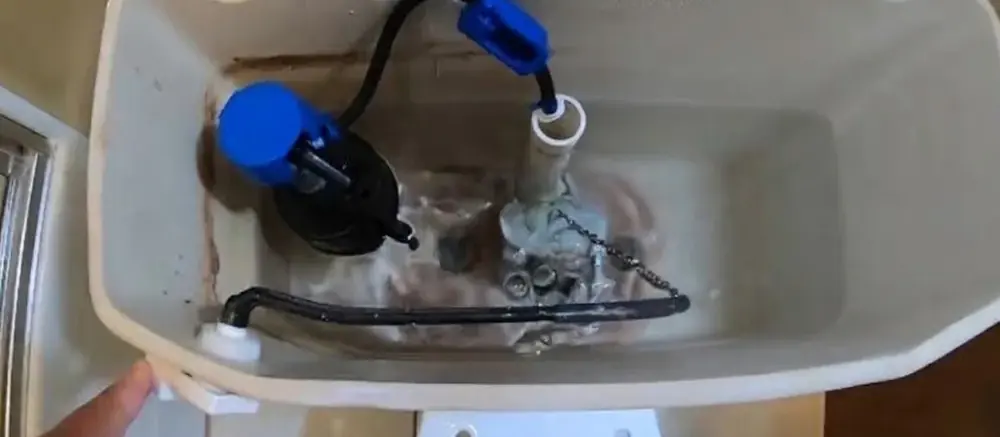
A running toilet is almost always one of three parts in the tank. The flapper that seals the bottom of the tank, the fill valve that refills it, or a chain or float set wrong so the tank never fully closes.
Gwinnett County Water Resources says a leaking toilet is most often a faulty flapper, and that a toilet running constantly can waste 200 gallons or more a day. The EPA's WaterSense program agrees that most toilet leaks come from old or worn flappers.
A toilet that hisses or refills on its own deserves a look this week.
Flapper and chain
A rubber flapper hardens and warps over the years. A chain that is too short holds it slightly open, and one that is too long can slip under it.
A dye test you can do before calling anyone
Gwinnett County Water Resources recommends a dye test for silent leaks. It costs nothing but half an hour.
- Remove the tank lid and drop in about a teaspoon of food coloring, or a dye tablet.
- Do not flush for 30 minutes.
- Look at the bowl. Any color showing means the flapper is leaking into it.
DWR gives out free toilet leak detection kits with dye tablets. The conservation line is 678.376.6722.
What people describe when a toilet needs more than a jiggle
Water around the base
A puddle that returns after you wipe it up often means a worn wax ring or a loose flange, not a cracked bowl.
The toilet rocks
Any rocking when you sit puts stress on the seal and can crack the flange over time, and it gets worse, not better.
Runs for a minute after each flush
The tank is not sealing, which is the flapper or fill valve at work.
Weak flush or gurgling
A partial blockage in the trap, or a vent or drain issue, so a fix to the toilet alone may not help.
Stain on the ceiling below
A leak at the base can travel through the subfloor, so treat a stain under a bathroom as urgent.
Rocking, flanges and wax rings
A toilet sits on a closet flange, the ring bolted to the floor over the drain pipe, and a wax ring seals the gap between them. If the flange is below the finished floor, cracked, or sits on soft subfloor, the toilet rocks and the seal breaks.
That is why the bowl is lifted off for a base leak. The plumber checks the flange, replaces the wax ring, and looks at the subfloor for soft wood from a long-term leak.
Over-tightening the closet bolts cracks the porcelain, so they are snugged evenly in turns.
Fix it yourself or call a plumber
Some tank repairs are routine homeowner work. Others lead to water damage if done wrong.
Reasonable to try yourself
- Replacing a flapper or adjusting the chain
- A plunger on a simple clog, with the stop ready
Better with a plumber
- A toilet that rocks or leaks at the base
- Sewage on the floor or a repeat backup
- A cracked bowl or tank
- Replacing the toilet when the flange or floor is damaged
Repair or replace the toilet
The flapper and fill valve are cheap parts, so most running toilets are repaired. Replacement earns its place in other cases.
| Situation | Usually | Why |
|---|---|---|
| Running or weak tank flush | Repair | Parts inside the tank are replaceable and the bowl is fine. |
| Base leak with sound flange | Reset with a new wax ring | The toilet is intact, only the seal failed. |
| Cracked bowl, tank or base | Replace | Porcelain cannot be repaired reliably. |
| Old toilet, repeated trouble | Replace | Newer models use less water per flush. |
The EPA says an average family can cut toilet water use by 20 to 60 percent by switching to WaterSense models. Georgia's plumbing code sets 1.28 gallons per flush for new toilets installed under it.
What changes the price of toilet work
A new flapper and a full replacement are different visits. You hear the number before work starts.
Repair or replace
Tank parts are a short job. Replacing a toilet adds the new fixture, removal and disposal of the old one.
Flange and subfloor
A cracked flange or soft floor from an old leak is extra work found when the toilet comes up.
The toilet you pick
Round or elongated bowl, one-piece or two-piece, and height all change the price.
Time of day
An overflowing toilet at night is an emergency visit, and that can be priced differently from a booked repair.
Home insurance usually covers sudden water damage from a failed fitting, not a toilet worn out through use. Read the policy, and ask your agent before you need it.
Want your real number?
Describe the job on the phone and get a clear price before any work starts.
Putting in a new toilet
Installing a toilet starts with the rough-in, the distance from the wall to the drain center. Many toilets are built for a 12-inch rough-in, but older homes vary, and a wrong match means the new bowl will not sit flush to the wall.
The old toilet comes up, the flange is inspected, a new wax ring or seal goes on, and the new bowl is set, bolted evenly and connected to a new supply line. Then it is flushed and checked for leaks at the base.
The City of Suwanee lists plumbing changes as work needing a building permit. For a straight swap of a toilet in the same spot, permit rules vary, so ask the city at 770-945-8996 or ask your installer.
When the toilet is not the real problem
A toilet that clogs again and again may point to the drain behind it. If more than one fixture gurgles, read about drain cleaning, and for a line that keeps failing, a sewer camera inspection shows what a plunger cannot.
Gwinnett County Water Resources says the homeowner owns the private sewer lateral, so a backup that starts at the street connection is yours to clear unless it is the county main. If neighbors are backing up too, DWR's 24/7 dispatch is 678.376.7000.
Homeowners near Duluth can call the same number.
According to the Georgia amendments to the plumbing code, new construction requires high efficiency toilets rated at 1.28 gallons per flush, tied to the WaterSense tank-type specification. Gwinnett County Water Resources also offers a free retrofit kit that includes toilet leak detection dye tablets.
Toilet questions
Yes. Yes, an overflowing toilet at night or on a weekend reaches the 24/7 line like any other emergency. Close the supply stop behind the toilet, do not flush again and call.
The flapper is usually worn and leaking water from the tank into the bowl, so the fill valve keeps topping it up. DWR says this is the most common toilet leak.
Not always, but it should be looked at soon. A rocking toilet strains the wax seal and can crack the flange, and a leak under the floor does damage out of sight.
Add a teaspoon of food coloring to the tank, wait 30 minutes without flushing, and look for color in the bowl. DWR offers free dye tablet kits at 678.376.6722.
If it cracks, leaks at the porcelain or keeps failing after repairs, replacement makes sense.