
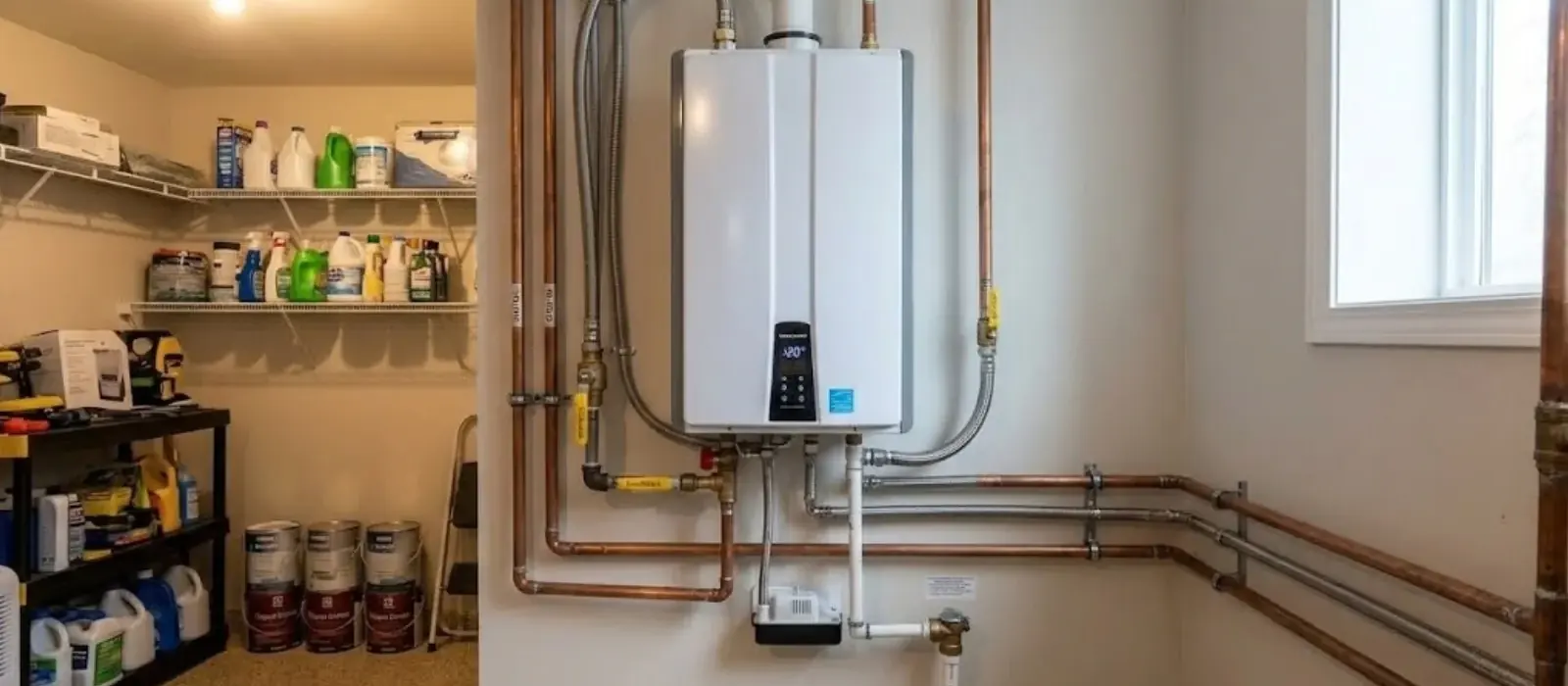
How a tankless heater works and what it asks of the house
A tankless water heater has no storage tank. When a hot tap opens, a flow sensor tells the unit to fire, and water passes through a heat exchanger and leaves hot. A gas model uses a burner and a fan-driven vent, and an electric model uses large heating elements with very high amperage.
That design changes what the house must supply. A gas unit often needs a larger gas line and special stainless or polypropylene vent pipe. An electric unit may need several 240-volt circuits, which an older panel cannot always supply.
Tankless heaters are rated by gallons per minute at a stated temperature rise, not by tank size. ENERGY STAR defines the figure as the gallons per minute the unit can supply while holding its nominal temperature, measured over a 67 degree rise.
Tankless against a tank, without the sales pitch
Neither choice is right for every house, and a tankless unit is not always the smarter buy.
A conventional tank
- Lower equipment and installation work in most homes
- Reuses existing gas, vent and electrical connections
- Runs out when the stored volume is used
- Wears from the inside as sediment and rust build
A tankless unit
- Hot water does not run out while the flow stays within its rating
- Takes less floor space and can mount on a wall
- Often needs a new vent, gas line or electrical circuit
- Needs periodic flushing to clear scale from the heat exchanger
- Short taps and very low flows can give a brief cold gap
Sizing a unit by flow and temperature rise
Tankless sizing starts with how many fixtures run at once and how much the incoming water has to be warmed. A shower, a kitchen faucet and a dishwasher together can add up to a flow that a small unit cannot keep hot.
Georgia's state minimum plumbing code says tankless heaters are sized and installed per the manufacturer's recommendations. That puts the sizing table inside the product's installation manual, not the plumbing code, so the installer works from the manual for the unit you pick.
Incoming water is colder in winter
The unit has to lift a fixed temperature, and the colder the supply, the lower the flow it can sustain at the same setting. A unit that feels generous in September may feel marginal in January.
A big household needs a plan, not a bigger label
A 100 gallon tank has no tankless equivalent, since tankless units are not sized in gallons. Households with several bathrooms may use two units or a larger model, and the installer should show you the flow math.
When a tankless unit needs repair
Most callers notice a pattern before an error code. The panel on the unit also flashes a code that narrows down the cause.
Cold water between hot bursts
Water that goes lukewarm or cold mid-shower can mean a clogged inlet screen, scale on the heat exchanger or a flow sensor that is not reading.
Error code or no ignition
A gas unit may fail to light from low gas pressure, a blocked vent or a dirty flame rod. Check the manual for the code, then call.
Water leaking from the unit
A tankless heater that has started to leak from the cabinet needs the water and power off right away, and a plumber to find the failed fitting or heat exchanger.
Reduced flow from every tap
The inlet filter may be plugged, or scale inside the heat exchanger may be narrowing the passage.
Popping or knocking sounds
Scale breaking off the exchanger or air in the line often causes it. A flush usually settles it.
Descaling flush, in the order it is done
Mineral scale and sediment coat the inside of the heat exchanger over time and cut flow and efficiency. Gwinnett County Water Resources reports very soft water, with hardness of roughly 1.05 to 1.87 grains per gallon, so Suwanee units scale slowly. A yearly flush is still the common manufacturer recommendation.
Power down and isolate
Unit power is switched off and the gas valve closed on a gas model. The hot and cold isolation valves are closed.
Hook up the flush kit
Two hoses attach to the service ports, one running to a small pump and a bucket of descaling solution, one returning to the bucket.
Circulate the solution
The pump moves the solution through the heat exchanger for about an hour, long enough to loosen scale.
Rinse and clean the screen
Clean water goes through to clear the solution, and the inlet filter screen is cleaned or replaced.
Restore and test
Valves are reopened, power and gas return, and the unit is fired and checked for steady output.
Gas supply, venting and why they matter
Gas-fired water heaters and their venting fall under the fuel gas code. A tankless gas unit burns a lot of gas at once, so the gas line must carry the full load. If the line is undersized, the unit may not hold temperature or may shut down under a heavy demand.
If you smell gas near the heater, leave the building and call the gas utility, for most homes Atlanta Gas Light at 877.427.4321, or 911, before calling a plumber. Do not try to find the leak yourself, and avoid switches and flames.
The City of Suwanee building permits page lists water heater replacement among work needing a permit, with the inspections line at 770-945-8996. Ask the installer how the permit and inspection will be handled for a tankless conversion, since new gas or vent work may be involved.
What decides a tankless price
Equipment is only part of it. The work around the unit often matters more, and you hear the clear price before work starts.
Unit capacity
Larger flow ratings and condensing models cost more.
Gas line and vent
A new gas run or sealed vent pipe through the wall or roof can be the biggest line item.
Electrical work
Electric models may need new breakers, larger wire or a panel upgrade.
Condensate and drain
Condensing gas units need a drain for acidic condensate.
Maintenance plan
Yearly flushing and filter cleaning are an ongoing cost that a tank does not have.
Home insurance usually covers sudden accidental leaks, not wear, scale damage or planned upgrades. Check the policy before assuming a failed heat exchanger is covered.
Want your real number?
Describe the job on the phone and get a clear price before any work starts.
Related plumbing and nearby areas
If the existing tank is still working, water heater repair may buy time before the switch. A failed tank that cannot wait is a water heater replacement job, and those can be answered with a tankless unit when the house can support it.
Homeowners in Duluth and the rest of the Gwinnett area call the same line.
Tankless water heater questions
Georgia's amended plumbing code requires thermal expansion control for storage water heaters on closed systems. The rule is written for storage heaters, so a tankless install follows the manufacturer's manual and your plumber's advice.
Manufacturers commonly call for a yearly flush. Gwinnett water is very soft by Gwinnett County Water Resources figures, so scale builds slowly, but the inlet screen still needs cleaning.
Not by volume, but it can run short on flow if too many fixtures open at once for its rating. Sizing the unit to your household avoids that.
Tankless units are rated in gallons per minute, not tank size. The installer works out the flow your house needs and may suggest one larger model or two units.
Repairs are part of the work, including inlet screen cleaning, flow sensor and igniter faults, error code diagnosis and descaling flushes. Same-day appointments are offered when available.