
Sewage backup emergency inside the house
If sewage is surfacing in a tub, shower or floor drain, call the 24/7 line now. Emergency sewer line cleaning in Suwanee, GA is handled at night and on weekends, and the main line is not something that improves by waiting.
Stop all water use right away, because the sewer line is full and every gallon you add comes back out of the lowest opening. Keep everyone away from the wet area and hold off on a mop until the line is open.
Sewer line cleaning is the removal of a blockage from the large drain that runs from the house to the sewer. It is a different job from clearing a single sink, and it usually starts at an outdoor cleanout.
- No flushing, laundry, dishwasher or showers.
- Block off the room with surfaced sewage and keep pets out.
- Move rugs and boxes away from the lowest drain.
- Turn off power to a flooded area only if you can reach the breaker while standing dry.
- Take a photo for your insurance file before cleanup begins.
Reading the backup: main line or something smaller
The pattern of symptoms decides where the technician goes first.
Everything is slow at once
The tub, sinks and toilets all lag together, which is the classic sign of a restricted main.
The lowest drain speaks first
A basement or ground-level tub bubbles or backs up before upstairs fixtures show anything.
Toilet flush shows up in the tub
Water shifting from one fixture to another means the line below them is blocked.
Sewer smell in the yard
A wet, odorous patch near the cleanout or along the line can mean the pipe is overflowing or leaking.
How a main line gets cleared, in order
The sequence matters, because cleaning the wrong way can push a clog deeper or miss the actual cause.
Open the cleanout
The cap comes off slowly, since a full line may release pressure and standing sewage.
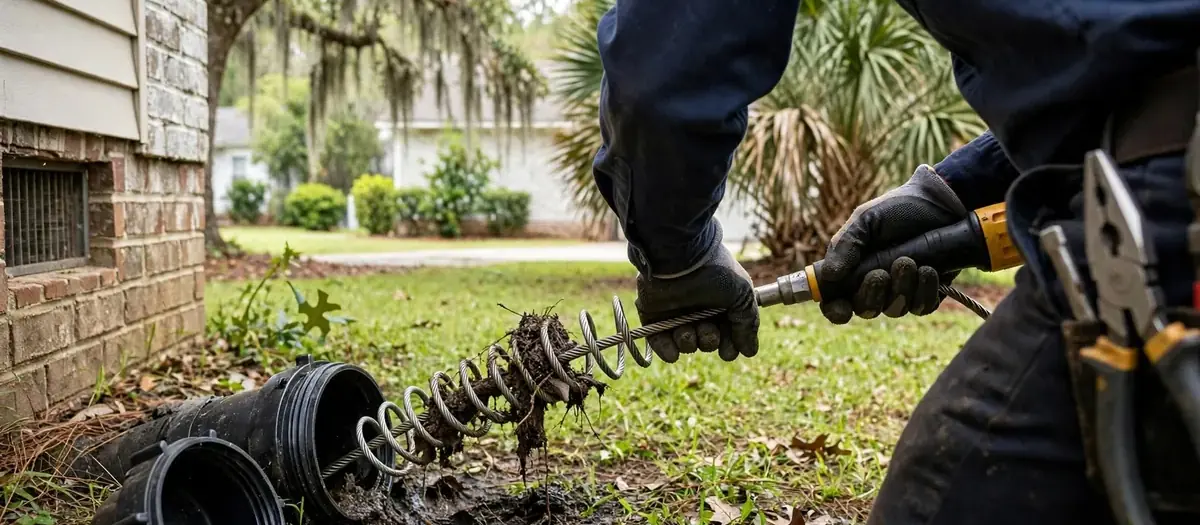
Run a sectional or drum cable
A machine with a cutting head moves through the line and cuts the blockage, with roots and paper being the usual finds.
Pull back what came out
The head brings back evidence, such as root hair, grease or a wipe mat, that points to the cause.
Flush the line with water
Water is run to confirm full flow all the way to the connection.
Camera look, if the clog is a repeat
A short camera pass shows a belly, an offset joint or a cracked section that cabling cannot cure.
Cleanouts, ownership and the county line
Gwinnett County Water Resources states that the property owner is responsible for the sewer lateral, the private pipe running from the house to the right-of-way. Gwinnett standards require a cleanout at the right-of-way, which the county maintains, and a second cleanout nearer the home belongs to the homeowner.
That tells you a lot before anyone arrives. If water stands in the cleanout near the house and the one at the street is full too, the blockage is likely downstream of both. If the near cleanout is dry, the blockage is probably between the house and that cap.
Neighbors with the same backup may mean the county main is the cause. Gwinnett County Water Resources lists 678.376.7000 as its 24/7 dispatch line for water and sewer emergencies.
If your house uses a septic system instead of county sewer, which some older Suwanee areas do, say so on the first call. A full septic tank behaves like a blocked main, and clearing a pipe will not fix it.
Clear it yourself or call a plumber
A small clog in a fixture is a fair DIY job. A main line is a different category.
Doing it yourself
- A rented drum machine can hurt a pipe if it is run the wrong way.
- You may not have a cleanout, and pulling a toilet to get in adds risk.
- You still carry the sewage, the splash and the cleanup.
- There is no camera to confirm the cause.
Calling a plumber
- Cutter heads can be matched to roots, grease or paper.
- Cleanout access is planned before cutting begins.
- A camera can show what the cable could not.
- If the pipe is damaged, repair can be discussed on the same visit and booked same-day when available.
What affects the price of cleaning a sewer line
A short branch with a fresh paper clog and a long main with roots in the joints are not the same job. The price is explained before work starts.
Distance to the blockage
A clog near the cleanout is quick, while one deep in a long run needs more cable and time.
What is blocking it
Paper and grease clear more easily than a dense mat of roots.
Access point
An outdoor cleanout is a direct path, and going in through a toilet or vent takes longer.
Camera work
A pass before or after cleaning adds time and gives real answers about the pipe.
Emergency hours
Late night or weekend dispatch can be priced separately from a daytime appointment.
Standard home policies often cover sudden water damage but may exclude the cost of clearing a clog, and sewer backup coverage is commonly sold as an extra. Read yours before an emergency.
Want your real number?
Describe the job on the phone and get a clear price before any work starts.
When cleaning is not enough
Repeat blockages usually have a cause the cable does not touch. A coated pipe wall calls for hydro jetting, and a bellied or cracked section calls for repair of the pipe itself.
If you want the cause identified without guessing, a scheduled sewer camera inspection records the whole line. Neighbors over in Duluth use the same dispatch line.
Sewer line cleaning questions
Yes. Dispatch stays open 24/7 for sewer backups, whatever the day or hour. Stop water use, keep people out of any sewage and call right away.
Look for a round cap, often plastic, in the yard near the foundation or close to the edge of the lot. Gwinnett County requires one at the right-of-way, and many homes also have one nearer the house.
Blockages in the private lateral, from the house to the right-of-way, are the owner's responsibility. If the street main seems to be the cause, call Gwinnett County Water Resources at 678.376.7000.
Yes. Roots find small openings at joints and grow into a mat inside the pipe, and cleaning removes them but does not close the opening.
Grease, food scraps, and wipes of any kind, including ones labeled flushable. Gwinnett County Water Resources notes that most FOG-related overflows happen on residential lines.