
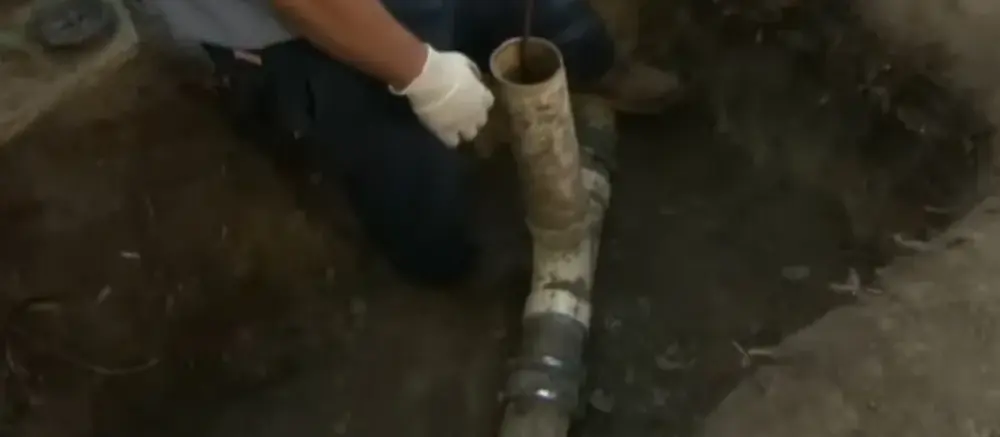
Active sewage leak or backup from a broken line
If sewage is backing up repeatedly, pooling in the yard or a hole has opened over the line, call the 24/7 line. Emergency sewer line repair in Suwanee, GA is dispatched at night and on weekends, and the first visit is often about making the situation safe before the permanent fix is planned.
While you wait, stop using water in the house. Every shower and flush adds to a line that is already failing, and in a broken pipe that water ends up in the soil.
Keep children and pets away from wet ground and from any opening in the yard. Do not dig it out yourself, because a trench at the wrong depth near a gas or electric line is a larger emergency than the sewer.
- Stop all water use.
- Rope off the wet or sunken area of the yard.
- Do not flush, even once.
- Photograph the backup and the yard for insurance.
- Call 811 before anyone digs, and know that utility locates take business days.
Repair starts with seeing the pipe
A sewer line repair is any fix to the pipe that carries wastewater from the house to the sewer connection, as opposed to clearing something that is stuck inside it. The right repair depends on what is wrong, where it sits and how deep, and a camera is how those facts are found.
A sewer camera is a waterproof lens on a flexible rod that runs through the cleanout. It records the pipe, shows cracks, offset joints, roots, bellies and collapses, and marks the distance to each so the dig, if there is one, is as small as possible.
If the line is not yet inspected, a scheduled camera inspection answers most of the open questions. In an emergency, a quick cleaning and camera pass often comes first.
Dig, line or pull: the repair options side by side
No single method is best. The choice depends on pipe condition, depth, what sits above the line and how much of it is damaged.
| Option | How it works | Fits when | Limits |
|---|---|---|---|
| Spot repair by excavation | A trench is dug to the damaged section, which is cut out and replaced with new pipe | The damage is one short section and the ground above is open | Digs up lawn, driveway or landscaping above the break |
| Pipe lining (cured-in-place) | A resin-soaked liner is pulled in and cured against the old pipe wall | The pipe is cracked or rough but still holds its shape | Shrinks the inside diameter slightly and cannot fix a collapse or a deep belly |
| Pipe bursting | A bursting head pulls new plastic pipe along the old path while it breaks the old pipe outward | The pipe is badly damaged across a long run and the path is straight | Needs entry and exit pits and care near other buried lines |
| Full replacement | The old line is dug out and new pipe goes in with proper slope | The pipe is collapsed, heavily bellied or fails in many places | Largest excavation and the longest disruption |
Lining and bursting are called trenchless methods. They reduce digging, but they are not always possible, and a technician should tell you plainly when they are not.
Signs the pipe is damaged, not just clogged
A clog clears with a cable. Damage keeps returning after clearing, and it has its own symptoms.
Backups again soon after cleaning
A line that stops up every few weeks usually has a root entry, a belly or an offset joint that cabling does not cure.
A sunken or soggy patch in the yard
Wet, sunken or unusually green ground along the line can mean sewage is escaping into the soil.
Sewer smell with no obvious source
An odor outside, or in the crawlspace or basement, can point to a leaking joint.
Gurgling toilets and slow drains
Air and water struggling past a partial collapse make noise in nearby fixtures.
Cracks in a slab or foundation
A leaking pipe under or near a slab can wash out soil and add settlement to the problem.
Trenchless repair: what it can and cannot do
Trenchless means working through existing access points, such as cleanouts, instead of opening a long trench. It saves landscaping, paving and sometimes a driveway, which matters when the line runs under a patio or mature tree roots.
A pipe liner needs a cleaned pipe, so the line is jetted first. After curing, the liner forms a pipe inside the old pipe, closing cracks and gaps at joints. It does not straighten a bellied pipe, and it does not repair a pipe that has collapsed.
Pipe bursting replaces the line outright with new plastic pipe, so it solves a more severe problem than lining does. It does need pits at both ends and a clear picture of what else is buried nearby.
Trenchless methods save restoration work but are not always cheaper in total. The footage settles it.
A short section on old cast iron
If your house has it
Homes with older drain piping may have cast iron under the floor or in the crawlspace. It was a durable material, but it corrodes from the inside over decades and can flake, scale and crack.
Many Suwanee houses are newer, since the city's own plan says about 60 percent of housing units were built in 2000 or later, so this is not the typical case. If your house is older, ask the technician to identify the pipe material on the camera footage.
Cast iron repairs can be a cut-out and replace with plastic pipe and the correct couplings, or a lining where the pipe is sound enough. The material is heavy and dangerous to cut without support, so this is not a DIY job.
Ownership, permits and a warning about reimbursement claims
Gwinnett County Water Resources says the property owner is responsible for the private sewer lateral, up to the edge of the right-of-way and including the connection to the public sewer. The county maintains a cleanout at the right-of-way, and the one closer to the home is the homeowner's.
The county also cautions homeowners to be wary of anyone who says work on private property will be reimbursed by the county. If a contractor makes that promise, ask for it in writing and check with Gwinnett County Water Resources before you sign anything.
The City of Suwanee lists plumbing changes among the work that needs a building permit, and its inspections line is 770-945-8996. Whether a given sewer repair needs one is a question to settle with the city before digging.
Georgia 811 asks for a ticket at least three business days before digging, so a planned excavation includes a wait for utility locates. If the home is on septic, the plan is different, and you should say so at the start.
According to Gwinnett County Water Resources, the private lateral runs to the edge of the right-of-way and the owner maintains the whole lateral, including the connection to the public sewer. The county also says that when your lowest fixture sits below the next upstream manhole, Georgia plumbing code requires a sanitary backwater valve.
Why one sewer repair costs more than another
The range between a short spot repair and a long replacement is wide, which is why the camera finding comes before the price. You hear the clear price before work starts.
Length of damaged pipe
A single cracked joint is a small repair, while many failing joints along 40 feet is a different project.
Depth and soil
A deeper trench needs shoring and more soil moved.
Surface above the line
Lawn is cheap to restore, while a driveway, patio or mature tree adds work.
Method
Lining, bursting and open-trench replacement each carry different equipment and labor.
Permits and locates
Time for utility marking and any city permit is part of the schedule.
Home insurance typically covers sudden accidental damage but not wear, age or root intrusion, and sewer line coverage is often an optional add-on. Gwinnett County suggests considering a rider for the lateral. Check your policy.
Want your real number?
Describe the job on the phone and get a clear price before any work starts.
Questions to ask before approving a repair
Repairs on a private sewer lateral are expensive enough that a few clear answers are worth asking for.
- Can I see the camera footage showing the damage and its distance from the cleanout?
- Is the pipe able to be lined, or does it need to be replaced, and why?
- Does the work need a city permit, and who is pulling it?
- What will the yard, driveway or landscaping look like afterward?
- Is the clear price for the whole job written down before work starts?
If the footage shows only a coated pipe, sewer line cleaning may be all that is needed. If you are in Lawrenceville and unsure, the same dispatch line covers plumbing service there as well.
Sewer line repair questions
Yes. Calls about a broken sewer line are dispatched around the clock, including holidays. Stop water use, keep people away from wet ground and call, and the first goal is to stabilize the situation before planning the permanent fix.
No. It spares the yard, but it cannot fix a collapsed pipe or a deep belly, and a lined pipe has a slightly smaller opening. The camera footage decides.
Under Gwinnett County Water Resources rules, the owner maintains the private sewer lateral, up to the edge of the right-of-way and the connection to the public system. The county maintains the main and the cleanout at the right-of-way.
Gwinnett County Water Resources warns homeowners to be cautious when a plumber says the county will reimburse private work. Ask for any such promise in writing and verify it with the county.
Gwinnett County says Georgia plumbing code requires a sanitary backwater valve if your lowest fixture is below the next upstream manhole. The homeowner maintains it, so ask whether your home needs one when the line is opened up.