
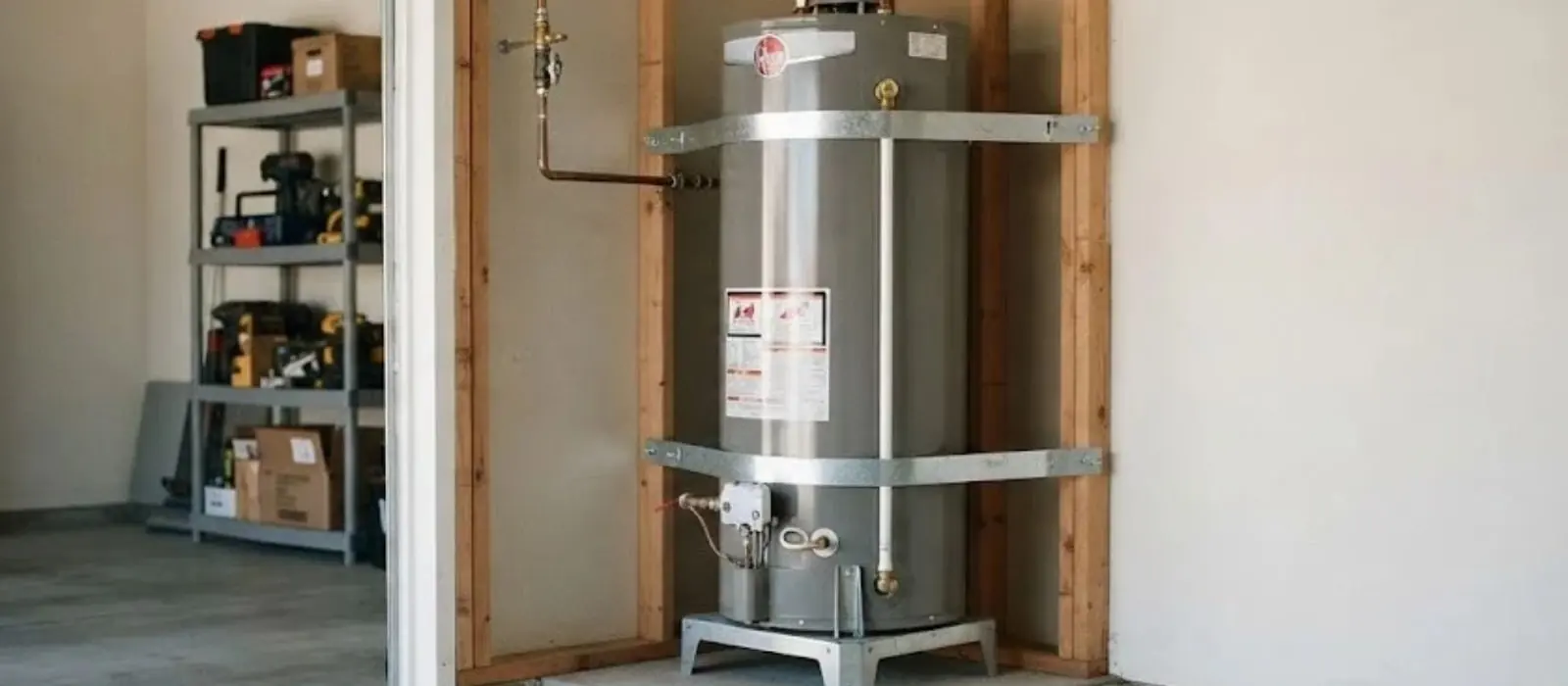
What installation covers and where it differs from a swap
Water heater installation is the work of setting a heater, connecting its water, fuel or power, venting any exhaust and testing the result. It covers a first-time heater in a new space, a change of fuel, a move from one room to another and a planned upgrade from an aging tank that still works.
A like-for-like swap on a failed tank is a narrower job, handled under water heater replacement. Installation is the broader category, and because nothing is flooding, you have time to choose the unit instead of taking whatever is on the shelf.
Decide these before anyone picks up a wrench
Most delays on a planned install come from questions that could have been answered a week earlier.
- Fuel: natural gas, electric or a hybrid heat pump unit. The data plate on the current heater shows what you have today.
- Size: first hour rating and tank volume, from the EnergyGuide label, not the gallon number alone.
- Location: garage, closet, attic or basement. Floor load, headroom and a drain pan path all depend on it.
- Venting: where the flue or exhaust will leave the house for gas models, and whether the old flue can be reused.
- Drainage: where the relief valve discharge pipe and any condensate line will run.
- Supply pressure: whether the house has a pressure reducing valve or backflow preventer, which makes it a closed system.
Photograph the data plate and the area around the heater before you call. It saves a round of questions.
Fuel and type at a glance
Each type trades installed cost, running cost and what the house has to provide. The table sums up the differences an installer will talk through.
| Type | What the house needs | Trade-off |
|---|---|---|
| Gas tank | Gas line, vent through roof or wall, combustion air | Fast recovery, needs a safe vent path |
| Electric tank | 240-volt circuit and breaker, no vent | Simple to place, slower recovery on the lower element |
| Hybrid heat pump | 240-volt circuit, open air space, condensate drain | Efficient, but bulkier and noisier near living space |
| Gas tankless | Larger gas line, special venting, a nearby drain | Endless hot water, higher upfront work |
| Electric tankless | Very high amperage, often a new panel circuit | Compact, but the electrical load can be the limit |
Which one is right depends on the house, not on the label. Ask the installer to explain the connection work for each option.
Sizing, placement and the code behind both
Georgia's state minimum plumbing code sizes residential water heaters by first hour rating, matched to bedrooms and bathrooms in a table, or by the manufacturer's recommendations. The code does not name a single tank size for every house, so the label on the heater is the number to read.
Gas heaters and venting
Gas distribution piping, gas-fired water heaters and their venting systems are regulated under the fuel gas code. A heater that vents poorly can push carbon monoxide into the house, so the flue slope, the connector size and the draft get checked on every gas install.
If you smell gas at any time, leave the building and call the gas utility, for most homes Atlanta Gas Light at 877.427.4321, or 911, before calling a plumber.
Closed systems and expansion tanks
A house with a pressure reducing valve, check valve or backflow preventer is a closed system, and a storage heater on that kind of supply needs a thermal expansion control device. Georgia's amended code asks for it and sets it at least 18 inches of pipe from the heater's cold inlet.
The pressure reducing valve is the homeowner's, according to Gwinnett County Water Resources, so a planned install is a good time to have it tested with a gauge.
How a planned install is laid out
Because nothing is leaking, the visit is organized and paced.
Walk-through
The installer looks at the space, reads the data plate and checks gas, electric, vent and drain routes.
Quote and permit plan
You hear the clear price and how the city permit will be handled.
Rough-in changes
A new circuit, gas stub, vent run or drain pan is put in before the heater is set.
Set and connect
The tank or tankless unit is placed, connected and fitted with a relief valve and discharge pipe.
Test and walk-through
Heat cycle, pressure, leak and venting checks are done, then you are shown the shutoffs and the thermostat.
Why installation prices differ from house to house
Two homes asking for the same 50 gallon heater can get very different numbers. The clear price covers equipment, labor and the code-required parts, and you hear it before work starts.
Equipment
Standard tank, high-recovery gas, heat pump and tankless models sit in very different price tiers.
Fuel changes
Converting from gas to electric or the reverse means new circuits, gas lines or venting.
Relocation
Moving the heater means new supply, drain and vent runs.
Required add-ons
Drain pan, expansion tank, sediment trap and new shutoff valves are common code items.
Permit and inspection
Permit fees and inspection scheduling vary by city and can add days.
Planned installs are not covered by home insurance since they are maintenance and upgrades, not sudden accidental damage. Read the policy if you are unsure what it covers.
Want your real number?
Describe the job on the phone and get a clear price before any work starts.
Reasons homeowners plan a new heater
The tank is a decade old
A heater past ten years is cheaper to replace on your schedule than at midnight with a flooded garage.
Hot water runs out too fast
A bigger household or a new soaking tub can outgrow the original tank.
A remodel moves the laundry or bath
New space needs a heater location, venting and drain routes planned from the start.
You are choosing tankless
The tankless water heater option needs gas, vent and electrical planning before the unit is bought.
Permits, inspections and asking the right questions
The City of Suwanee building permits page lists plumbing changes and water heater replacement as work that needs a building permit, and gives 770-945-8996 as the inspections number. Ask the installer how the permit will be pulled and when the inspection will happen.
Permit rules for other cities, including Lawrenceville, differ, so ask the city for your address. A heater that is working hard and showing its age may also be a candidate for water heater repair first, if the tank is otherwise sound.
Water heater installation questions
Start with what the house already has. A gas line and a vent make gas easy, and a spare 240-volt circuit makes electric or hybrid easy. Hybrid units need open air and a drain for condensate.
The City of Suwanee building permits page lists water heater replacement among work needing a building permit. For other changes, such as fuel conversions, call the inspections line at 770-945-8996.
Sometimes. The flue must be the right size, slope and material for the new unit, and old flexible connectors are normally replaced.
If the house has a pressure reducing valve, check valve or backflow preventer on the supply, the code calls for thermal expansion control on a storage heater. The installer can tell by looking at the supply piping.
Same-day appointments are offered when available, and planned installs can be scheduled to fit your week. Call with the details, and you get the clear price before work starts.