
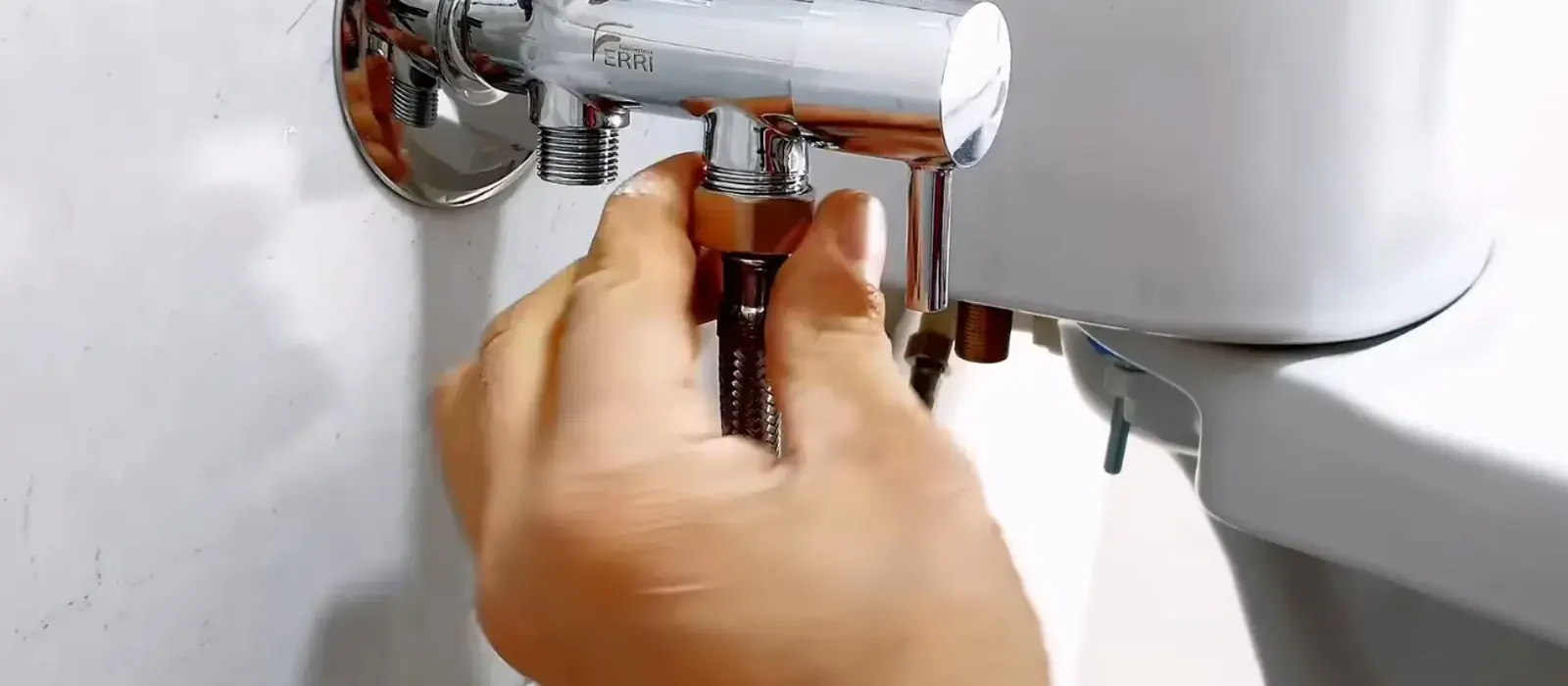
What installing a one-piece toilet actually involves
A one-piece toilet has the tank and bowl molded as a single unit, so there is no tank-to-bowl gasket to leak and no seam to clean. The tradeoff is weight and a lower margin for error. You cannot carry the bowl and tank separately, and you cannot set the fixture down on the flange to adjust it.
The job is simple to describe. Shut the water, remove the old toilet, check the flange, set a new wax ring, lower the toilet straight down onto the bolts, tighten, connect the supply and test. Most failures come from skipping the check of the flange or from overtightening a nut on glazed porcelain.
What to have on the floor before you start
Laying out everything first keeps you from leaving an open drain pipe uncovered while you drive to the store.
- New wax ring or wax-free seal sized for your flange
- Closet bolts and plastic caps (new ones, the old brass bolts are often corroded)
- New braided supply line, since the old one can be rigid and cracked
- Adjustable wrench, putty knife, level and a rag or old towels
- A rag or wooden plug to stop sewer gas from the open pipe
- A helper who can lift the toilet with you
Measure from the wall behind the toilet to the center of the closet bolts. A standard rough-in is 12 inches, and a toilet built for a different rough-in will not sit right.
Removing the old toilet and setting the new one
Work in this order. Each step protects the next.
Shut off and drain
Close the supply valve, flush, and sponge the last water out of the tank and bowl so it does not slosh when you lift.
Disconnect and unbolt
Unscrew the supply line from the tank, pop the caps off the closet bolts and remove the nuts. A seized nut can be cut with a hacksaw blade.
Rock and lift
Rock the toilet gently to break the wax seal, then lift straight up with a helper. Set it on towels, not directly on finished flooring.
Scrape and inspect
Remove old wax from the flange with a putty knife. The flange should sit flat on, or slightly above, the finished floor and be solid, not cracked or rusted.
Seat the new toilet
Place the wax ring on the flange or on the toilet horn, drop the toilet straight onto the bolts without twisting it, and press down evenly.
Tighten, connect, test
Alternate between nuts, a little at a time, until the base stops rocking. Reconnect the supply, open the valve, flush several times and check the base for any seep.
Suwanee note: the 1.28 gallon rule and the city permit page
Georgia's amended plumbing code, published by the Department of Community Affairs, defines a high efficiency toilet as one whose average flush volume does not exceed 1.28 gallons. The state code requires high efficiency fixtures in all new construction. A replacement in an existing home is not a new build, so check the box label: a 1.28 gallon per flush toilet meets the benchmark either way.
The EPA WaterSense page on residential toilets says labeled models use 1.28 gallons per flush or less while still providing equal or superior performance, and that the average family can reduce water used for toilets by 20 to 60 percent. In practice, look for the WaterSense label on the box and on the tank, and keep the paperwork.
The City of Suwanee building permit page says permits are required for changes to plumbing systems. It does not spell out whether a like-for-like toilet swap counts, so call the city inspections line at 770-945-8996 before you start, and ask your installer to confirm the answer for your address.
Install it yourself or hire the job out
A straight swap on a sound floor is a reasonable weekend job. Problems under the floor are not.
Doing it yourself fits when
- The old toilet came out cleanly and the flange is solid.
- The floor is flat and dry with no soft spots.
- You have a helper to lift the fixture.
- You are replacing the same rough-in size.
A plumber fits when
- The flange is cracked, rusted or below the finished floor.
- The subfloor is soft or stained around the base.
- The drain line is slow or the toilet has clogged repeatedly.
- You are moving the toilet or adding a new bathroom.
One-piece, two-piece and wall-hung compared
The type you choose changes how hard the install is and what can fail later.
| Type | Install effort | Watch for |
|---|---|---|
| One-piece | Heavy, no tank bolts to align | Needs a flat floor and careful lowering |
| Two-piece | Lighter pieces, easier to carry | Tank-to-bowl gasket and bolts can leak |
| Wall-hung | Needs an in-wall carrier and framing | Plumber job, not a swap |
Any type sits on the same closet flange, except wall-hung, which uses a carrier.
Signs the flange or drain is the real problem
If the floor around the old toilet was stained, spongy or smelled of sewage, the leak was at the wax ring for a while. The subfloor may need repair before a new fixture goes on.
A toilet that backs up after a clean install is a drain question, not a toilet question. A main-line clog can show up first at the lowest fixture, which is where drain cleaning or a sewer line cleaning visit comes in.
We cover Suwanee and the nearby cities of Duluth and Lawrenceville.
One-piece toilet installation questions
It is possible but not wise. The fixture is heavy and awkward, and dropping it onto the flange can crack either the toilet or the flange. Have a helper lift and set it.
Yes. A used ring will not compress into a fresh seal, so a toilet set back on an old ring tends to leak at the base. Wax-free seals are an alternative, follow the toilet maker's instructions.
Snug and even, a little at a time on each side. Stop when the toilet no longer rocks. Porcelain cracks under force, and a cracked base means buying the toilet again.
The City of Suwanee building permit page lists plumbing changes as needing a permit but does not address a like-for-like toilet swap. Call the city at 770-945-8996 and ask before you start.
Georgia's amended plumbing code sets the high efficiency toilet limit at an average of 1.28 gallons per flush, and WaterSense labeled toilets use 1.28 gallons or less per the EPA.