
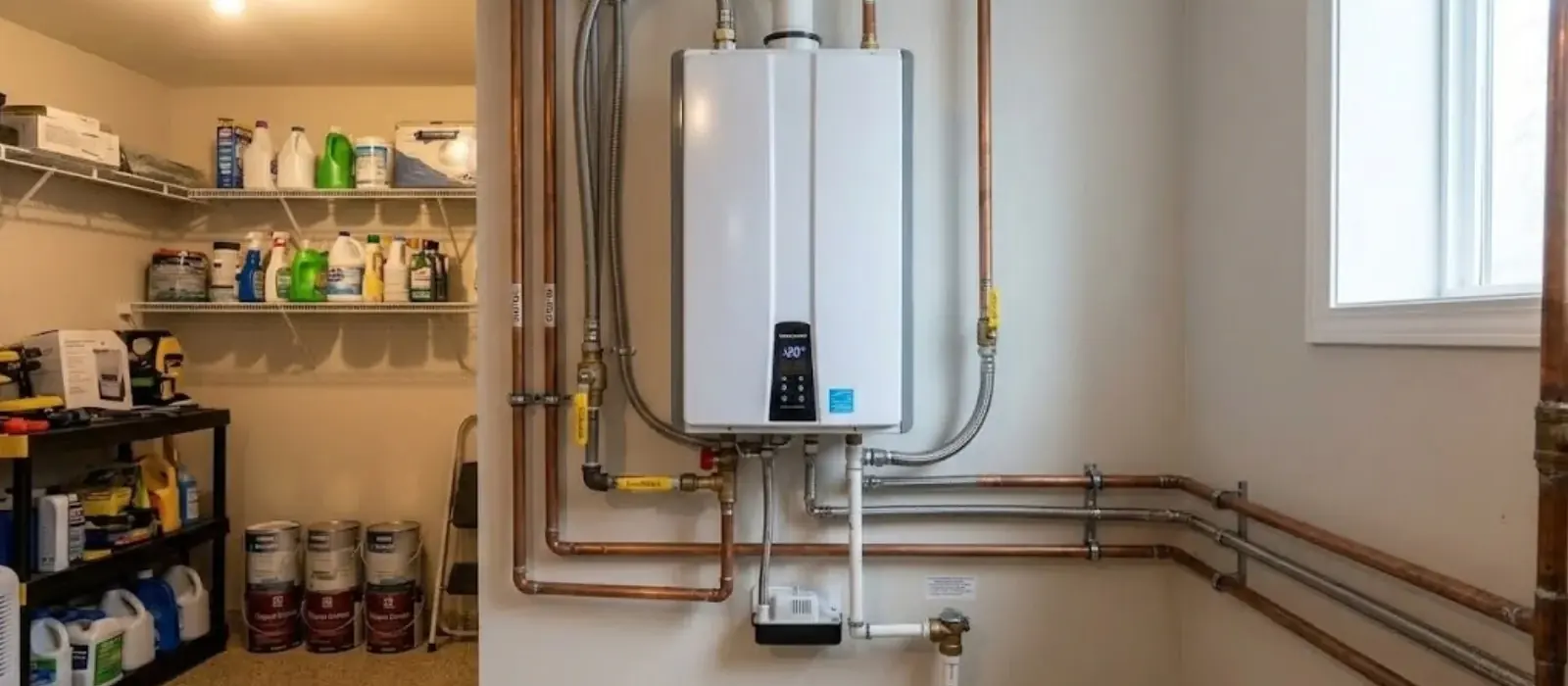
The two numbers that decide the size
A tankless heater has no storage, so it only works while water is flowing. Two numbers decide whether it keeps up. The first is flow rate in gallons per minute, which is how much hot water you draw at the same moment. The second is temperature rise, the number of degrees the heater must add between the cold water entering the house and the hot water you want at the tap.
A large home with several bathrooms usually fails on the first number, not the second. Two showers, a dishwasher and a laundry cycle can all call for hot water at 7 a.m., and the heater has to cover the total or the last fixture on the line runs lukewarm.
Do the arithmetic yourself in four steps
None of this needs a brochure. You need a pencil, the label on each fixture and a thermometer.
List what runs together
Pick the busiest realistic hour. Maybe two showers and one kitchen faucet. Ignore fixtures that never overlap with those.
Add the flow of each fixture
Georgia's plumbing code definitions for new high efficiency fixtures cap a shower head at an average of 2.5 gallons per minute, a lavatory faucet at 1.5 and a kitchen faucet at 2.0. Two showers plus one kitchen faucet is 2.5 + 2.5 + 2.0 = 7.0 gallons per minute. Older fixtures can run higher, so check the stamp on yours.
Find your temperature rise
Measure the cold tap in winter with a kitchen thermometer after the water has run a minute. If it reads 55 degrees and you want 120 at the shower, the rise is 120 minus 55, which is 65 degrees.
Compare to the unit's rating
Every tankless heater lists how many gallons per minute it delivers at a given rise. Pick a unit whose rating at your rise meets or beats your total from step two.
Tank or tankless for a big household
Replacing a large tank with a tankless unit changes how hot water is delivered, so the comparison is not just size against size.
| Question | Large storage tank | Tankless |
|---|---|---|
| What limits hot water? | The tank runs out after the stored volume is used | Flow rate, once the burner or element hits its ceiling |
| Back to back showers | Fine until the tank empties, then a recovery wait | Steady, if total flow stays within the rating |
| Many fixtures at once | Pulls from the same reserve | Can come up short on the last fixture |
| Gas line and venting | Existing setup often reused | Often needs a larger gas line and different venting |
| Electric homes | Common and simple | Large units draw heavy electrical load, so panel capacity matters |
These are general trade-offs. A site visit settles what your house can actually support.
Matching the old tank's output
If you are replacing a big tank, the label on it is a useful starting point. Tank heaters carry a first hour rating, the gallons of hot water delivered in one hour starting full. Georgia's state minimum plumbing code, the International Plumbing Code with Georgia amendments, has a residential sizing table that sets first hour rating by bedrooms and baths. One row lists 67 gallons for four bedrooms and three to three and a half baths.
The same table carries a footnote that tankless heaters are sized and installed per the manufacturer's recommendations. That means the code does not give you a gallons per minute number. The manufacturer's sizing chart and your own fixture list do, which is why the four steps above matter.
Suwanee note: gas, electric and who sets the rules
Georgia's plumbing code amendment packet from the state Department of Community Affairs says fuel-gas-fired water heaters and their venting are regulated by the International Fuel Gas Code, not the plumbing chapter. In practice, a gas tankless unit needs its vent and gas supply sized for that unit, and a larger-flow model often needs more of both than your old tank did. Ask your installer to size the gas line, not just swap the heater.
The City of Suwanee building permits page lists plumbing changes and water heater replacement as work that needs a building permit, and gives 770-945-8996 for inspection questions. Confirm with the city before the unit is ordered so the permit does not hold up the install.
The same state packet says boilers and water heaters above 200,000 BTU per hour, 210 degrees Fahrenheit or 120 gallons capacity fall under separate state rules. Most houses are well below that, but ask your installer if you are sizing for an unusually large property. If you smell gas at any point, leave the building and call the gas utility, for most homes Atlanta Gas Light at 877.427.4321, or 911, before you call a plumber.
Sizing it yourself versus having it sized on site
The arithmetic is a good screen. Several things only show up once someone looks at the house.
What you can do at home
- List fixtures and their flow stamps
- Measure winter cold water temperature
- Check the label on your current tank
- Find your gas meter or electrical panel rating
What a plumber confirms
- Whether the gas line or panel can feed a bigger unit
- Vent routing and clearances
- Water pressure at the heater inlet
- Whether two smaller units suit a long house better than one
When two units beat one
In a large or sprawling house, one heater at the garage can be a long pipe run from the far bathroom. Waiting for hot water to travel that distance wastes water and patience, and the extra pipe loses heat on the way.
Some homes split the load with two units, or keep a small tank near the far bathrooms. This costs more up front, so it makes sense mainly when the run is long or when peak demand would push a single unit to its ceiling. Our tankless water heater service page covers how the units are set up.
Pairing the decision with the rest of the job
A tankless swap is more than a heater swap. New gas piping, venting or a dedicated electrical circuit can all sit behind the decision, which is why a straight water heater installation quote can look very different from a tankless one. If the old tank has already failed, water heater replacement covers what happens when you need hot water quickly.
Homeowners in nearby Lawrenceville and Duluth size the same way, since the arithmetic is identical. Only the incoming water temperature and the house layout change.
Manufacturers publish flow rate and temperature rise tables for each model, and following the installation instructions that come with the unit is part of a correct install. According to the Georgia amendments to the plumbing code, new construction requires showerheads that average no more than 2.5 gallons per minute, a useful number when you add up flow.
Tankless sizing questions
No. Tankless heaters have no tank, so they are rated in gallons per minute at a given temperature rise. If you are used to a large tank, the equivalent question is how many gallons per minute your busiest hour needs.
Run the cold tap for a minute in winter and read it with a kitchen thermometer. Subtract that number from the temperature you want at the shower. The difference is your rise.
It does not run out like a tank, but it can fall short if the fixtures running at once call for more gallons per minute than the unit can heat at your rise. That is a sizing problem, not a defect.
The City of Suwanee building permits page lists plumbing changes and water heater replacement as needing a building permit. Call the city inspections line at 770-945-8996 to confirm what applies to your address.
Sometimes, but not always. A tankless unit usually needs more gas flow than a tank at full fire, so the existing pipe size and meter capacity have to be checked first. Your installer should confirm this in writing.