
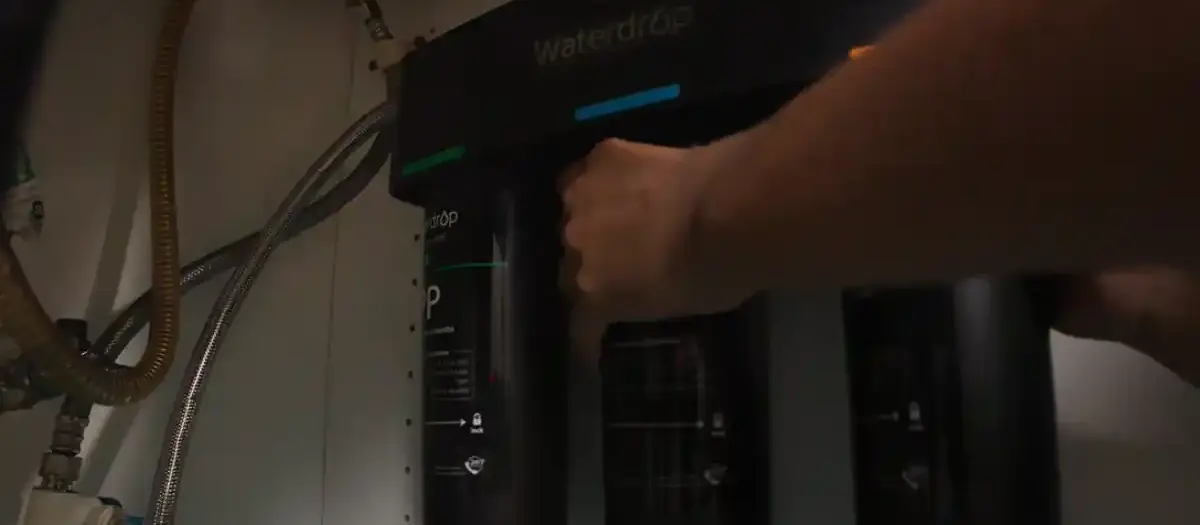
What a UV light does in a water line
A UV water system is a sealed chamber with an ultraviolet lamp inside a quartz sleeve. Water flows past the lamp, and the light is meant to disinfect it. That is a different job from a filter, which catches sediment and particles. Most units go on the main line where water enters the house, so every tap gets treated water.
The lamp runs on household power and has a rated life in hours, and the quartz sleeve has to be cleaned or replaced on the maker's schedule. A plain unit with no alarm gives no sign when the lamp burns out or the power drops. Ask for a model with a lamp-out indicator and a replacement reminder.
This post does not list what UV can and cannot treat, because we could not confirm those limits from a public health source we can point you to. Ask the installer for the product's third-party certification, and read what scope the paperwork lists. That sheet tells you more than a sales pitch does.
Suwanee note: what already comes out of a county tap
Gwinnett County Water Resources says the county receives its drinking water supply from Lake Sidney Lanier. The water travels to one of two filter plants, Shoal Creek or Lanier, and its 2025 water quality report says chlorine is added to keep the water clean through more than 4,000 miles of pipes. If you are a county water customer, the water is treated before it reaches your meter, so a UV lamp is not the first purchase to make.
The same report lists chlorine at an average of 1.43 ppm against a maximum allowed level of 4 ppm, and says there were no U.S. EPA Safe Drinking Water Act violations in 2025. These are county-wide figures, not a reading at your tap. Call Customer Care at 678.376.6800 for the current report and read it before you spend money on equipment.
The county's water quality web page lists total hardness at 1.05 to 1.87 grains per gallon, with an average of 1.34, per Gwinnett County Water Resources. Hardness is a mineral measurement, a separate question from disinfection. If scale on fixtures is your worry, that number belongs in the conversation before any lamp does.
If your tap water tastes or smells wrong, the county asks you to report it to its 24/7 dispatch line at 678.376.7000. It also says it does not send employees to test tap water inside customers' homes. A caller at the door offering a free county water test is not from Water Resources.
Find out what you are treating first
Equipment should answer a test result, not a worry. A home test strip from a hardware store reads chlorine and hardness at the tap in a few minutes. A water lab can report bacteria and minerals that a strip cannot see.
Draw the sample the way the lab instructs, usually from a cold tap after the water has run, in the bottle they supply. A result you can hold in your hand lets the installer size the system and lets you compare two quotes on the same facts.
Before you buy a UV system
Run through this list, and keep the answers with the installation paperwork.
- Get the current water quality report if you are on county water, or a lab report if you are on a well.
- Ask the installer for the unit's third-party certification and what it covers.
- Ask where the lamp, sleeve and power connection sit, and how the lamp is replaced.
- Ask what the unit does when the lamp fails, and whether it sounds an alarm.
- Ask whether a permit applies to your address, since the City of Suwanee lists plumbing changes as needing one.
- Ask for the clear price, parts and labor, before work starts.
County water or private well: where UV fits
The two situations start from very different places. This table is a starting point, not a prescription.
| Question | Gwinnett County water customer | Private well |
|---|---|---|
| Disinfection already done? | Yes, chlorine is added at the county plants and carried through the pipes | Not by anyone but you |
| Who tests the source? | The county publishes a yearly report with data from January 1 to December 31 | You do, using the state and EPA schedule |
| First step | Read the report and test your own tap | Bacterial and chemical lab test |
| Where UV fits | Optional, only if a test or a special need gives a reason | A disinfection option to discuss once results are in |
If you are not sure which group you are in, ask Gwinnett Water Resources whether the address has a county meter.
If your home is on a private well
The Georgia Department of Public Health recommends a bacterial test, total coliform and fecal coliform, of well water every year. It also recommends a chemical screening, called a W33C analysis, every three years. The agency says this testing may be available through your local County Environmental Health office.
The EPA gives a similar yearly list: total coliform bacteria, nitrates, total dissolved solids and pH. We did not find a Gwinnett page that describes well testing, so call Environmental Health before assuming the county will do it. Gwinnett's septic page lists 770.963.5132 for Environmental Health.
Results decide what, if anything, to install. A lamp should be chosen against a specific lab result, never ahead of one.
Natural filtering versus a treatment system
People searching for natural water filtration usually mean sand, gravel, charcoal, or the slow trip water takes through soil. Those materials do catch particles, and layered sand and charcoal filters are a real, old technique. The trouble is that nothing measures the result, so you cannot know what got through.
A treatment plant works the other way round. Gwinnett pulls water from Lake Lanier, filters it at the Shoal Creek or Lanier plant, disinfects it, and publishes numbers every year. A homemade or natural filter has no report, and a well has only the tests you order.
Suwanee Creek is known for frequent flooding, according to the Gwinnett hazard mitigation plan. After floodwater reaches a wellhead, a fresh bacterial test is the sensible next step, and the Environmental Health office can say how to collect a sample.
Who installs it and where to look next
A UV unit is a small plumbing and electrical job. A plumber cuts into the main line, adds shutoff valves and unions so the unit can be serviced, and the unit gets its own outlet. Our plumbing installation work covers this kind of add-on, and a clean main-line connection matters if the line ever needs water line repair.
Neighbors in Duluth and Lawrenceville draw from the same county system, so the county report applies there too.
UV water filtration questions
Not as a starting point. The county says chlorine is added to keep the water clean through its pipes, and it published no EPA Safe Drinking Water Act violations in 2025. Read the report and test your tap first, then decide.
Use a home test strip for chlorine and hardness, or send a sample to a lab for bacteria and minerals. The county report describes the system as a whole, not the pipes inside your house.
The Georgia Department of Public Health recommends a bacterial test every year and a W33C chemical screening every three years. Your local County Environmental Health office may offer the testing.
Gwinnett Water Resources asks you to call its 24/7 dispatch line at 678.376.7000. The county does not send employees to test water inside your home, so be wary of an unexpected visitor who says otherwise.
Nobody can say without a test. Natural materials can catch particles, but they are not a measured treatment step. Have the water lab-tested before drinking it.